
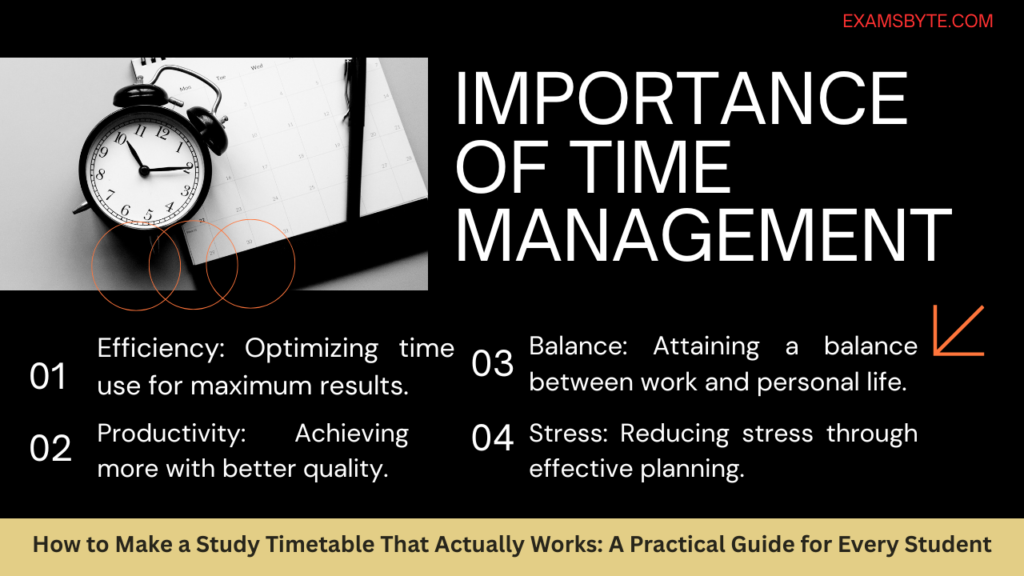
Have you ever created a study timetable with great enthusiasm, only to stop following it after a few days?
If your answer is yes, you’re not alone. Many students spend time designing beautiful timetables but struggle to stick to them. The problem isn’t a lack of motivation—it’s that the timetable doesn’t match their daily routine.
A good study timetable should be simple, realistic, and flexible. It should help you study consistently without making you feel stressed or overwhelmed.
In this guide, you’ll learn how to create a study timetable that fits your lifestyle and helps you prepare for exams more effectively.
- Why Do You Need a Study Timetable?
- Step 1: Set a Clear Goal
- Step 2: Know Your Daily Routine
- Step 3: Find Your Most Productive Time
- Step 4: Prioritize Difficult Subjects
- Step 5: Break Study Time into Small Sessions
- Step 6: Include Revision Every Day
- Step 7: Practice Questions Regularly
- Step 8: Keep Time for Rest
- Step 9: Sleep Well
- Step 10: Review Your Timetable Every Week
- Sample Daily Study Timetable
- Common Mistakes Students Make
- Tips to Follow Your Timetable Successfully
- Frequently Asked Questions (FAQs)
- Final Thoughts
Why Do You Need a Study Timetable?
A study timetable helps you:
- Stay organized throughout the week.
- Cover your syllabus on time.
- Reduce exam stress.
- Avoid last-minute cramming.
- Build a regular study habit.
- Balance study, rest, and personal time.
Instead of wondering, “What should I study today?” you’ll already have a clear plan.
These are the 10 Steps how to make a better study time table thats actually works.
Step 1: Set a Clear Goal
Before creating your timetable, ask yourself:
- Which exam are you preparing for?
- When is your exam?
- How many subjects do you have?
- Which subjects are difficult for you?
Write your goals down.
For example:
- Complete Mathematics Chapter 5 this week.
- Revise Science every Saturday.
- Solve 30 reasoning questions daily.
Clear goals make your timetable meaningful
Step 2: Know Your Daily Routine
Don’t copy someone else’s timetable from YouTube or social media.
Instead, understand your own routine.
Think about:
- School or college timings
- Tuition classes
- Travel time
- Family responsibilities
- Sleep schedule
Your timetable should fit your life—not the other way around.
Step 3: Find Your Most Productive Time
Some students concentrate best in the morning, while others perform better in the evening.
Notice when you feel most focused.
Use those hours for your most difficult subjects.
For example:
- Morning: Mathematics
- Evening: Science
- Night: Revision
Studying difficult subjects during your peak concentration hours improves learning.
Step 4: Prioritize Difficult Subjects
Most students make the mistake of studying only their favorite subjects.
Instead, spend more time on subjects that need improvement.
A simple rule is:
- Difficult subjects: 50% of study time
- Moderate subjects: 30%
- Easy subjects: 20%
This helps improve your overall performance.
Step 5: Break Study Time into Small Sessions
Studying continuously for five or six hours is usually not effective.
Instead, divide your study into focused sessions.
A good example is:
- 50 minutes of focused study
- 10-minute break
Or try the Pomodoro Technique:
- 25 minutes of study
- 5-minute break
Short breaks help you stay fresh and focused.
Step 6: Include Revision Every Day
Revision is just as important as learning new topics.
Reserve at least 30–60 minutes each day for revision.
You can revise:
- Class notes
- Important formulas
- Vocabulary
- Previous mistakes
- Short summaries
Daily revision improves long-term memory.
Step 7: Practice Questions Regularly
Reading alone is not enough.
After completing a topic, solve:
- MCQs
- Previous year questions
- Sample papers
- Mock tests
Practice helps you identify weak areas and improve your speed and accuracy.
Step 8: Keep Time for Rest
A timetable should not include only study.
Include time for:
- Meals
- Exercise
- Walking
- Family
- Hobbies
- Sleep
A healthy mind learns better than a tired one.
Step 9: Sleep Well
Many students stay awake late at night before exams.
Lack of sleep affects concentration, memory, and problem-solving skills.
Aim for 7–8 hours of quality sleep every night.
A well-rested brain performs much better.
Step 10: Review Your Timetable Every Week
Life changes.
Your timetable should change too.
Every Sunday, ask yourself:
- Which subjects did I complete?
- Which tasks are still pending?
- Which subjects need more attention?
Then adjust your timetable for the next week.
This keeps your study plan realistic.

Sample Daily Study Timetable
| Time | Activity |
|---|---|
| 6:00–6:30 AM | Wake up and exercise |
| 6:30–7:30 AM | Mathematics |
| School/College | Regular classes |
| 5:00–6:00 PM | Science |
| 6:00–6:20 PM | Break |
| 6:20–7:20 PM | English |
| 7:20–8:00 PM | Dinner |
| 8:00–9:00 PM | Revision |
| 9:00–9:30 PM | Practice Questions |
| 10:00 PM | Sleep |
Remember, this is only an example. Customize it according to your routine.
Common Mistakes Students Make
Avoid these common mistakes:
- Creating an unrealistic timetable
- Ignoring revision
- Skipping breaks
- Studying only favorite subjects
- Sleeping too little
- Comparing your timetable with others
- Not updating the timetable regularly
Small, consistent improvements are more effective than perfect plans that you cannot follow.
Tips to Follow Your Timetable Successfully
- Start with small daily goals.
- Keep your study area clean.
- Turn off unnecessary phone notifications.
- Tick completed tasks to stay motivated.
- Reward yourself after finishing important tasks.
- Focus on consistency rather than perfection.
- Remember, following a simple timetable every day is more valuable than creating a complicated one that you never use
Frequently Asked Questions (FAQs)
How many hours should I study every day?
The number of hours depends on your class, exam, and learning pace. Instead of focusing only on hours, focus on completing your daily study goals with full concentration.
Should I study every subject daily?
Not necessarily. However, it is helpful to revise at least one previously studied topic each day while concentrating on one or two main subjects.
Is it okay to change my timetable?
Yes. A timetable should be flexible. If your routine changes or you notice that a schedule isn’t working, adjust it rather than abando
Can I use a digital timetable?
Yes. Many students prefer using calendar apps, task managers, or digital planners. Choose the method that helps you stay consistent.
Final Thoughts
A study timetable is not about studying every minute of the day. It is about using your time wisely and building a routine you can maintain for months, not just a few days.
Keep your timetable realistic, review it regularly, and don’t be discouraged if you miss a session. Simply return to your plan and continue.
Success in exams doesn’t come from studying the longest—it comes from studying consistently.
Start today with a timetable that fits your life, and take one step closer to achieving your academic goals. if you want to Improve your Concentration while studying then there is a 12 simple Tips that really work.